

Bits Versus Atoms
Source: Richard Blount
Market shifts are always obvious after the fact. You look back at any major market event and the response you frequently get is, “Of course, it was obvious.” One then wonders why so many investors get taken out to the woodshed, if these events were indeed obvious. This hindsight bias is common, but it can have a greater impact in capital markets, especially when your life savings are on the line. There is also the risk of being too early in a trade, even when all the numbers are telling one thing but the market is doing something else. We are seeing things that tell us something might be happening in the market and it’s telling us to start following hard assets and be careful of tech, specifically AI. This is bits (tech) versus atoms (the physical world).
Investors can fixate on absolute returns but risk adjusted returns in our opinion are more important to maintaining wealth. Since the Great Financial Crisis (GFC), North American investors have funneled several trillion dollars into passive index funds, with $22.4 trillion net inflows in the last 10 years alone. This has resulted in a huge concentration of money in the biggest companies with the Magnificent Seven (or Mag 7) stocks accounting for approximately 34.9% of the S&P 500.
Passive investing can be hugely powerful in bull markets, but taking profits should be encouraged. If you owned the S&P 500 Index during the GFC, the maximum peak-to-trough drawdown was ~55.25% from October 9, 2007 to March 9, 2009. Now imagine you’ve retired one year prior to the GFC, and you’ve lost more than half of your savings. Do you think you could have stayed retired? Could you have resisted the urge to sell everything at the worst possible time because you were scared? If you left everything alone and, stayed passive you would have come out fine, but in my experience, almost no one has the discipline to ignore their investments when it feels like the world is collapsing.
Successful investing is sometimes what you don’t do when you feel your worst and what you do do when you think everything is fine. This brings me to a point I’ve made previously: active and passive investing should be defined, but almost never is. Just because you own a passive investment, like an ETF, few people buy the investment and forget about it. The investment gets traded and anything you do, other than ignore it, is active.
When an index is this concentrated and this much money is parked in passive funds, investors are not diversified in the way they think. Wealth Professional magazine wrote an article on how a Picton Investments poll shows only 57% of investors say they’re familiar with index concentration. The survey data also showed that investor confidence in their own knowledge is high, when actual understanding is struggling to keep up with a changing environment. This is the classic Dunning-Kruger cognitive bias.
To illustrate my point, let’s look at one day in the market, specifically October 15, 2026. That day, we saw a broad selloff in tech stocks, particularly focused on those with high AI concentration. Vanguard’s S&P 500 ETF (VOO) returned +0.33% that day. On the surface, nothing to see here, just a boring day in the markets. However, if you look beneath the index, it shows a much different story. The Mag 7 was down approximately -1.0%, but the remaining 493 companies were up approximately 1.4%. This is what we mean by concentration risk. Now, imagine if this trend were to take place over the course of months, with the largest companies continuing to lose value. They would have an oversized impact on your returns, even if you owned the entire S&P 500 by default.
However, there’s another thing we noticed on October 15: a potential rotation from bits to atoms.
Let me be clear, one day does not a trend make, and you do not make major investment decisions based on one day’s trading. But the top three sectors of that day were health care (+1.84%), materials (+1.83%), and consumer discretionary (+1.70%). On the October 15 episode of the Prof G Markets podcast, Paul Kedrosky, Managing Partner at SK Ventures, talks about the potential AI bubble. There is the cost of debt restructuring for neoclouds, like CoreWeave (CRWV) to higher interest rates. There has also been a 13-fold annual decrease in the cost of tokens, a major source of income for neocloud companies. This means they have to grow token sales 1,300 percent/year just to maintain current revenue.
There is also a wall of refinancing between 2028 and 2032 that’s going to make cost of capital much more expensive. Now, add the private market valuation of Open AI and Anthropic, combined (and what we’re likely to see when they go public), and it is already more than the peak NASDAQ valuation when it crashed in 2000. These are all factors to watch, as we see price/earnings multiples for the stock market stay relatively fairly priced, private market valuations grow and debt markets explode in size.
Passive investing can work when everything is growing but it seems no one is driving the bus in relation to the markets due to the huge number of index investors. Jeff Currie, Senior Advisor at The Carlyle Group, brought this up at Canoe Financial’s recent CEO series. He said that retail investors could drive the next wave of active investment and cause a passive investment environment to undo. He argued that if this huge amount of money is sitting on cruise control, you could see a large unwinding of wealth in the form of panic selling. Panic selling (or selling of any kind), again is not passive.
As of this writing, we’re over 17 years into this secular bull market; the longest bull market was 18 years, from 1982 to 2000. The experience of a downturn among investors (and many professionals), has been forgotten and history suggests a rotation into new leadership may not be far off, specifically from cyclical growth sectors (technology, AI) to defensive and cyclical value (consumer staples, energy), as illustrated on October 15. Tech stocks don’t automatically move in the opposite direction as energy stocks, but they frequently do, during periods of sector rotation or when rising oil prices trigger inflation and higher interest rates. I’m sure this sounds familiar to anyone buying groceries or renewing their mortgage.
Bits to atoms.
History can be a guide but as the old saying goes, it doesn’t repeat but rhymes. Tech and AI are building data centres at an amazing pace, and they need raw materials and energy to do it. The Mag 7 has broken out of the consolidation pattern it’s been in for the past four months which has bullish overtones. But aren’t we in a bubble? Confused yet?
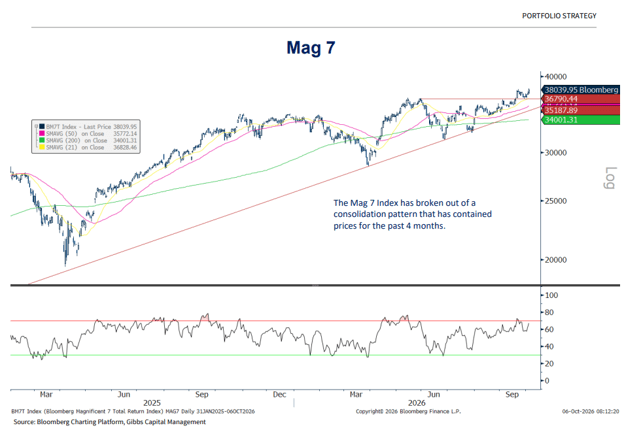
I know I said earlier that when tech slows, energy picks up. But what happens when bits are chasing atoms? This might mean that we could see two sectors that are usually divergent to each other historically move in the same direction for a time, and for a longer time than we might otherwise expect.
The point of all of this is not to confuse you, but to show how complex a market we’re in. It also matters that while we don’t make predictions as to when a market might rise or fall, we make value judgements with regard to safety with our clients’ capital. It’s why we continue to hold tech even though debt levels are rising in that sector, but we are actively taking profits when they present themselves. We make sure we are diversified but allow judgement calls like not putting almost 35% of our portfolios into a sector that could very quickly fall in value.
You only have to remember Nvidia’s 66% drop in value in 2021-2022 for reference. When we focus on risk-adjusted returns, our result in 2022 was to go down less than half that of the broader market, which fell more than 27%. This type of active management allowed us to accelerate returns going into the rising market after 2022’s selloff, by deploying capital we had on the sidelines. This is winning by not losing.
This newsletter has been prepared by Stephen Maser of Raymond James Ltd. (“RJL”). It expresses the opinions of the writer, and not necessarily those of RJL. Statistics, factual data and other information are from sources believed to be reliable but accuracy cannot be guaranteed. It is furnished on the basis and understanding that RJL is to be under no liability whatsoever in respect thereof. It is for information purposes only and is not to be construed as an offer or solicitation for the sale or purchase of securities. RJL, its officers, directors, employees and their families may from time to time invest in the securities discussed in this newsletter. This provides links to other Internet sites for the convenience of users. Raymond James Ltd. is not responsible for the availability or content of these external sites, nor does Raymond James Ltd endorse, warrant or guarantee the products, services or information described or offered at these other Internet sites. Users cannot assume that the external sites will abide by the same Privacy Policy which Raymond James Ltd adheres to. It is intended for distribution only in those jurisdictions where RJL is registered as a dealer in securities. Distribution or dissemination of this newsletter in any other jurisdiction is strictly prohibited. This newsletter is not intended for nor should it be distributed to any person residing in the USA. Raymond James Limited is a Member Canadian Investor Protection Fund. Raymond James (USA) Ltd. (RJLU) advisors may only conduct business with residents of the states and/or jurisdictions for which they are properly registered. Raymond James (USA) Ltd., member FINRA/SIPC.